Expert Deck Builder Serving Erwin, NC 28339
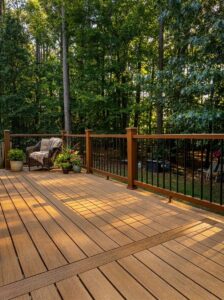
Looking for a reliable deck builder in Erwin, NC? Titan Decks LLC delivers durable, high-quality decks and porches designed to withstand the local climate. We specialize in composite decks, wood decks, deck repairs, and porch installations, serving Erwin, NC 28339 and surrounding areas.
Whether you’re building a new deck, upgrading an old one, or adding a screened porch, we provide professional craftsmanship that adds beauty and value to your home.
Why Homeowners in Erwin Choose Titan Decks
Erwin experiences humid summers, rainy seasons, and occasional storms, so your deck must be built with strong materials and expert construction. Our decks are designed to:
Resist rot, warping, and fading
Stand up to local weather conditions
Provide safe, long-lasting outdoor spaces
Enhance your home’s style and value
We combine quality materials with skilled workmanship to deliver decks that last for years.
Deck Services We Offer in Erwin, NC
We provide full-service deck building and repairs, including:
Composite Decks
Low-maintenance, durable, and weather-resistant — ideal for Erwin homes.
Wood Decks
Classic, affordable, and customizable for your property.
Deck Repairs & Upgrades
Fix structural issues, replace boards, or modernize your deck.
Porches & Screened Porches
Add functional and beautiful outdoor living space to your home.
Areas We Serve Around Erwin, NC
We proudly serve Erwin, NC 28339 and surrounding ZIP codes:
28339 (Erwin)
28334 (Dunn)
27521 (Coats)
27504 (Benson)
27546 (Lillington)
We understand local building codes, HOA requirements, and unique home styles in Harnett County.
The Professional’s Guide to Deck & Porch Engineering in Erwin
Building decks and porches in Erwin, North Carolina is not the same as building them in other parts of the country. Soil conditions, humidity levels, chemical treatment of lumber, local permitting requirements, and UV exposure from the southern sun all affect long-term performance.
As a professional Deck Builder in Erwin, structural integrity begins long before the first board is installed. True durability comes from understanding regional soil mechanics, moisture behavior, corrosion science, and local building codes specific to Harnett County, NC.
This guide breaks down the engineering principles behind properly built outdoor structures in Erwin — and explains why hiring an experienced Custom Deck Contractor or Porch Builder matters.
NC Soil Mechanics & Foundation Stability in Erwin, NC
Understanding Cecil Red Clay in the Piedmont Region
Erwin sits within North Carolina’s Piedmont geological zone, where Cecil Red Clay dominates subsurface soil composition. This clay is highly reactive, meaning it exhibits significant shrink-swell behavior based on moisture content.
Cecil clay contains fine particles that expand when saturated and contract when dry. The result is cyclical vertical movement that exerts pressure on shallow foundations.
In practical terms:
During prolonged rain, soil expands and pushes upward.
During dry periods, soil contracts and settles.
This constant movement causes deck heave, post shifting, and ledger separation when improperly engineered.
Many builders still rely on shallow 12-inch-deep footings because that is the minimum code depth in some jurisdictions. In Erwin, that depth is frequently insufficient due to seasonal soil movement.
Why 12-Inch Footings Fail in Erwin
Minimum-depth footings sit within the active moisture zone. This is the upper soil layer most affected by rainfall and drought cycles.
When clay expands:
Upward pressure lifts deck posts.
Uneven expansion causes racking.
Lateral movement stresses connection hardware.
Over time, this results in:
Unlevel decking
Stair misalignment
Guardrail instability
As a professional Deck Builder in Erwin, we often install:
Oversized 18–24 inch diameter concrete pads
Deepened footings extending below active clay layers
Reinforced footings with rebar cages
Helical piers for high-movement areas
Helical Piers: Advanced Foundation Stabilization
Helical piers are steel shafts with helical plates driven deep into stable soil strata below the shrink-swell zone. They bypass reactive clay entirely.
Advantages include:
Immediate load-bearing capacity
Resistance to uplift pressure
Long-term vertical stability
Ideal for sloped or water-retaining properties
For many Erwin properties, especially those near low-lying areas, helical systems provide superior performance over traditional concrete footings.
A knowledgeable Custom Deck Contractor understands that foundation engineering is the difference between a 5-year deck and a 30-year deck.
Structural Engineering for NC Humidity
The Micro-Climate of North Carolina
Erwin experiences high humidity levels throughout much of the year. Dew points frequently exceed 70°F in summer months. This creates a micro-climate under decks where moisture accumulates and air stagnates.
Trapped humidity causes:
Fungal decay
Mold growth
Board cupping
Fastener corrosion
Joist rot
Why Moisture Traps Destroy Deck Framing
When humid air becomes trapped beneath decking:
Moisture condenses on joists.
Wood fibers absorb water.
Expansion occurs across grain direction.
Boards begin to cup or twist.
Moisture combined with limited airflow accelerates fungal decay organisms. These organisms digest lignin in wood, weakening structural fibers.
As an experienced Porch Builder, we engineer decks to prevent moisture entrapment.
Joist Tape (Butyl Tape) Science
Butyl joist tape is a self-adhering membrane placed over the top of joists before decking installation.
It:
Seals screw penetrations
Prevents standing water from entering fastener holes
Blocks UV exposure
Reduces rot at critical load points
Without joist tape, fastener penetrations create capillary channels that wick water into framing members.
Cross-Ventilation Engineering
Ventilation is achieved through:
Open-perimeter designs
Vented skirting panels
Minimum 12 inches ground clearance
Airflow channel spacing
Proper cross-ventilation allows:
Moist air to escape
Dry air circulation
Reduced microbial growth
Humidity control is engineering — not guesswork.
Fastener Science & Chemical Compatibility
ACQ Pressure-Treated Lumber & Corrosion
Modern pressure-treated lumber uses Alkaline Copper Quaternary (ACQ) as a preservative. ACQ contains high copper concentrations.
Copper is highly corrosive when in contact with certain metals.
Standard electro-galvanized fasteners react with ACQ through galvanic corrosion.
This leads to:
Rust expansion
Fastener failure
Ledger detachment
Structural compromise
Approved Fastener Types
Only the following should be used:
304-grade stainless steel
316-grade stainless steel (marine-grade)
G185 hot-dipped galvanized fasteners
The difference between G60 and G185 galvanization is coating thickness. G185 provides nearly triple the corrosion resistance.
As a professional Deck Builder in Erwin, we specify fasteners based on exposure level and material type.
Permitting & Code Compliance in Harnett County, NC
Local Code Requirements
Harnett County enforces the North Carolina Residential Code.
Decks require:
Building permit
Footing inspection
Framing inspection
Final inspection
Impervious Surface Limits
Certain subdivisions limit impervious surface coverage. This includes:
Decks
Porches
Concrete pads
Roofed structures
Typical maximum lot coverage ranges from 24%–35%.
Failure to calculate this can result in:
Permit denial
HOA violations
Forced structure reduction
An experienced Custom Deck Contractor ensures deck sizing complies with lot coverage limits.
Guardrail & Stair Code
Guard height: 36 inches minimum
Baluster spacing: less than 4 inches
Stair rise/run ratio compliance
Load-bearing requirements for guard posts
Proper code adherence protects homeowner liability.
Material Longevity in the NC Sun
UV Exposure in Erwin
North Carolina receives intense UV exposure during summer months. South-facing decks experience extreme surface temperatures.
Material selection matters.
Capped Composite vs PVC
Capped Composite (Trex, TimberTech):
Wood-plastic core
Protective polymer shell
Moderate heat retention
High scratch resistance
PVC (Azek):
100% synthetic
Superior moisture resistance
Higher UV stability
Lower organic expansion
Heat Mitigation Technology
Modern decking includes:
Infrared-reflective pigments
Advanced polymer caps
Reduced heat absorption formulas
For south-facing projects in Erwin, heat mitigation is critical to prevent surface overheating.
Technical Comparison Table
| Feature | Pressure-Treated Wood | Capped Composite | PVC |
|---|---|---|---|
| Structural Strength | High | Moderate | Moderate |
| Moisture Resistance | Moderate | High | Very High |
| UV Stability | Low | High | Very High |
| Maintenance | High | Low | Very Low |
| Heat Retention | Moderate | Moderate-High | Moderate |
| Lifespan (NC Climate) | 10–15 yrs | 25+ yrs | 30+ yrs |
| Fastener Compatibility | Requires G185/Stainless | Hidden clip systems | Stainless recommended |
Final Engineering Perspective
Building in Erwin requires understanding:
Reactive clay soil behavior
Humidity-driven decay cycles
ACQ fastener chemistry
County permit enforcement
UV material degradation
Hiring an experienced Deck Builder in Erwin, Porch Builder, or Custom Deck Contractor ensures your structure is engineered — not just assembled.
A properly engineered deck is a structural extension of your home. When designed with soil science, moisture control, corrosion prevention, and code compliance in mind, it will perform safely for decades.
Lateral Load Resistance & Ledger Attachment Engineering
One of the most overlooked structural failures in residential decks occurs at the ledger board — the structural member that connects the deck to the home. In North Carolina, improper ledger attachment is one of the leading causes of deck collapse.
The ledger must resist:
Vertical gravity loads
Lateral live loads from occupants
Wind uplift forces
Shear movement from soil shifting
In Erwin, where soil movement can subtly shift foundations, ledger engineering becomes even more critical.
Proper Ledger Attachment Methods
A professionally engineered ledger system should include:
½-inch or ⅝-inch hot-dipped galvanized or stainless structural lag screws or through-bolts
Fastener spacing calculated based on deck span and joist length
Solid rim joist backing — never attached to brick veneer alone
Continuous flashing above the ledger to prevent water intrusion
Brick veneer homes, common throughout Harnett County, require special consideration. The ledger must be attached to the structural band joist behind the veneer — not the brick itself. Improper installation into masonry veneer can create hidden structural weaknesses.
Lateral Load Connectors
Modern code increasingly requires lateral load connectors (such as Simpson DTT2Z or equivalent). These connect deck framing directly into the home’s structural framing system and prevent separation during dynamic loads.
As a Custom Deck Contractor, we engineer lateral connections to exceed minimum requirements whenever possible.
Live Load & Deflection Standards
North Carolina residential code requires decks to support a minimum live load of 40 pounds per square foot. However, engineered decks in Erwin often experience higher real-world loads during gatherings or events.
To reduce deflection and “bounce,” we evaluate:
Joist spacing (12” vs 16” on center)
Beam sizing and span tables
Post-to-beam connection strength
Blocking and bridging for load distribution
Minimizing deflection not only improves comfort but also extends fastener longevity and board stability.
A skilled Porch Builder understands that engineering for stiffness — not just strength — results in a deck that feels solid underfoot for decades.
Built to Impress. Proven to Last.
Trusted Craftsmanship, Backed by the Best
We partner with industry-leading brands to bring you top-quality decks, porches, exteriors, and pools—ensuring beauty, durability, and peace of mind with every installation.