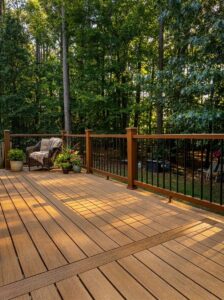
Trusted Deck Builder Serving Newton Grove, NC 28366
Looking for a professional deck builder in Newton Grove, NC? Titan Decks LLC delivers high-quality decks, porches, and deck repairs built to last. We serve Newton Grove 28366 and nearby areas, providing composite decks, wood decks, deck repairs, and porch installations.
Whether you want a new deck, upgrade an old one, or add a screened porch, our team combines quality materials with expert craftsmanship to enhance your home’s style and value.
Whether you’re building a new deck, upgrading an old one, or adding a screened porch, we provide professional craftsmanship that adds beauty and value to your home.
Why Homeowners in Newton Grove Choose Titan Decks
About The Services
Newton Grove’s weather brings hot, humid summers and occasional heavy rains, which makes durable, well-constructed decks essential. Our decks are designed to:
Resist rot, warping, and fading
Withstand local climate conditions
Provide safe, long-lasting outdoor living spaces
Add visual appeal and value to your home
Each deck is built with care to ensure it lasts for years, even in North Carolina’s variable weather.
Deck Services We Offer in Newton Grove, NC
We offer full-service deck building and repairs for Newton Grove homeowners:
Composite Decks
Strong, low-maintenance, and perfect for Newton Grove homes.
Wood Decks
Classic, customizable, and budget-friendly.
Deck Resurface & Upgrades
From fixing boards to structural improvements, we restore your deck to a safe and attractive condition.
Porches & Screened Porches
Add functional outdoor living space with style and durability.
Areas We Serve Around Newton Grove, NC
We proudly serve Newton Grove, NC 28366 and nearby ZIP codes:
28366 (Newton Grove)
28334 (Dunn)
28339 (Erwin)
27521 (Coats)
27504 (Benson)
We know local building codes, HOA requirements, and the specific needs of Harnett County homes.
Get a Free Deck Estimate in Newton Grove, NC
Ready to build or upgrade your deck? Contact Titan Decks LLC today for a free estimate in Newton Grove, NC 28366.
Advanced Deck & Porch Engineering in Newton Grove, NC
Deck construction in Newton Grove requires engineering precision tailored to rural Sampson County soil conditions, agricultural moisture patterns, open-lot wind exposure, and long-term climate cycling. Unlike dense suburban neighborhoods, Newton Grove properties often sit on wide, flat parcels with clay-heavy subsoil and seasonal water retention concerns.
As a professional Deck Builder in Newton Grove, structural planning begins before excavation. Soil bearing capacity, footing depth, drainage flow, moisture management, and connection integrity all determine whether a deck remains stable for decades or begins shifting within a few seasons.
A deck is not simply lumber assembled outdoors — it is a structural system transferring load from decking to framing, beams, posts, and finally into the soil. Proper engineering at every stage is what separates long-lasting outdoor living spaces from premature failures.
Soil Mechanics & Foundation Stability in Newton Grove
Sampson County Clay Composition
Newton Grove lies in the Coastal Plain region of North Carolina. Soils commonly include:
Clay-dominant sublayers
Sandy clay loam
Silty agricultural fill
Poorly compacted rural backfill
High moisture-retention zones
Clay-heavy soils are particularly reactive to moisture.
When saturated:
Clay particles expand
Soil volume increases
Uplift pressure develops
When dry:
Soil contracts
Gaps form beneath footings
Structural settlement occurs
This shrink-swell cycle is the primary cause of deck heave in rural Sampson County.
Why Minimum 12-Inch Footings Are Often Inadequate
The minimum 12-inch depth required by code frequently places footings within the “active soil zone” — the upper layer most influenced by rainfall and drought cycles.
In Newton Grove, shallow footings may experience:
Differential uplift
Post rotation
Stair misalignment
Deck surface slope changes
As a seasoned Custom Deck Contractor, we frequently install:
20–24 inch diameter reinforced concrete footings
Depths extending 24–36 inches
Rebar cages to resist cracking
Bell-bottom flared bases
Increasing footing diameter reduces pounds-per-square-foot soil pressure and increases stability.
Soil Bearing Capacity Calculations
Average bearing capacity in this region ranges from 1,500–2,000 psf.
Deck loads include:
Dead load (framing and decking weight)
Live load (40 psf minimum per NC code)
Concentrated loads (grills, seating areas, gatherings)
Lateral wind forces
Proper footing sizing ensures safe load distribution.
Helical Pier Systems for Drainage-Prone Areas
Properties near low-lying agricultural runoff zones benefit from helical pier foundations.
Helical piers:
Extend below unstable soil
Anchor into load-bearing strata
Resist uplift
Provide immediate structural capacity
A knowledgeable Deck Builder in Newton Grove evaluates soil conditions before excavation.
Structural Engineering for Humidity & Agricultural Exposure
Micro-Climate in Newton Grove
Newton Grove experiences:
High summer humidity
Frequent heavy rain
Elevated dew points
Agricultural moisture influence
Humidity directly affects wood fiber structure.
When moisture exceeds 20%:
Wood fibers swell
Boards cup
Fastener tension shifts
Surface checking develops
Repeated cycling weakens structural components.
Fungal Decay Risk
Fungal organisms require:
Moisture
Warm temperatures
Oxygen
Under decks with limited ventilation, these conditions are common.
Decay weakens:
Joists
Beams
Ledger boards
Rim joists
Butyl Joist Tape Engineering
Butyl joist tape:
Seals fastener penetrations
Prevents capillary moisture migration
Protects framing
Extends joist life significantly
Each unprotected fastener hole becomes a decay pathway.
Cross-Ventilation Strategy
Proper airflow requires:
12–18 inch ground clearance
Open-perimeter skirting
Ventilated panels
Spaced decking boards
Ventilation dramatically reduces moisture retention.
A skilled Porch Builder integrates airflow science into design.
Fastener Chemistry & Corrosion Resistance
ACQ Lumber & Galvanic Reaction
ACQ-treated lumber contains copper.
Copper accelerates corrosion when paired with incompatible metals.
In humid farm-adjacent environments:
Electro-galvanized fasteners deteriorate rapidly
Zinc coatings break down
Steel oxidizes
Structural joints weaken
Approved Hardware
We use:
304 stainless steel
316 stainless steel
G185 hot-dipped galvanized hardware
G185 provides nearly triple the zinc protection of G60.
Fastener selection determines structural lifespan.
Load Path Engineering & Structural Math
Continuous Load Transfer
Deck loads transfer through:
Deck boards → Joists → Beams → Posts → Footings → Soil
Weak connections interrupt structural integrity.
Beam Span Engineering
Beam size depends on:
Tributary load area
Post spacing
Deck depth
Material species
For large rural decks, we often use:
Double or triple 2×12 beams
LVL engineered beams
Reduced post spacing
Reducing deflection improves durability.
Lateral Bracing & Wind Exposure
Open farmland increases wind velocity.
We incorporate:
Diagonal bracing
Tension ties
Hurricane-rated connectors
Through-bolted beam-to-post connections
Rigid framing resists sway and uplift.
Roof Load Engineering for Covered & Screened Porches
Covered porches introduce:
Dead load from roofing materials
Live load requirements
Wind uplift pressure
Lateral shear forces
Load must transfer:
Roof → Rafters → Beams → Posts → Footings → Soil
We calculate:
Tributary roof area
Beam depth
Post compression strength
Connector ratings
Proper flashing prevents ledger water intrusion.
Thermal Expansion & UV Performance
South-facing decks in Newton Grove experience intense sun.
UV exposure leads to:
Polymer oxidation
Wood lignin breakdown
Surface fading
Composite and PVC materials expand more than wood.
We engineer:
Expansion gaps
Floating clip systems
End gap allowances
Heat mitigation pigments reduce surface temperature.
Technical Comparison Table
| Feature | Pressure-Treated Wood | Capped Composite | PVC |
|---|---|---|---|
| Structural Rigidity | High | Moderate | Moderate |
| Moisture Resistance | Moderate | High | Very High |
| UV Resistance | Low | High | Very High |
| Expansion Rate | Low | Moderate | High |
| Maintenance | High | Low | Very Low |
| Lifespan in Newton Grove | 10–15 yrs | 25+ yrs | 30+ yrs |
| Hardware Requirement | Stainless/G185 | Hidden Clips | Stainless |
Code Compliance in Sampson County (Newton Grove)
Deck construction requires:
Footing inspection
Framing inspection
Final safety inspection
Guard requirements:
36-inch guard height
<4-inch baluster spacing
Code-compliant stair geometry
Compliance protects safety and resale value.
Final Engineering Perspective for Newton Grove
Deck and porch construction in Newton Grove requires:
Deep reinforced footings
Clay stabilization awareness
Humidity mitigation systems
Corrosion-resistant hardware
Wind uplift engineering
Roof load calculations
UV-resistant materials
Strict code compliance
Hiring a professional Deck Builder in Newton Grove, experienced Porch Builder, or specialized Custom Deck Contractor ensures your outdoor structure is engineered for Sampson County’s unique soil and climate conditions.
Proper engineering transforms a deck from a temporary platform into a structural extension designed to perform safely for decades.
Mitigating Agricultural Runoff and High-Table Moisture in Newton Grove
Because Newton Grove is surrounded by active agricultural land, the soil often holds a higher moisture content than a typical suburban lot. This is due to local irrigation patterns and the flat topography of Sampson County, which can lead to standing water or “soft spots” near your home’s foundation. For a deck builder, this is a critical variable. A deck built on poorly drained soil will suffer from “joist rot” and “fastener pull-out” much faster than one in a dry environment.
When Titan Decks engineers a project in Newton Grove, we prioritize sub-structural ventilation. We often recommend a minimum clearance between the ground and the deck framing to allow for constant airflow. Additionally, we utilize a specialized “Gravel-and-Poly” barrier system under the deck footprint for low-clearance builds. This prevents ground moisture from evaporating directly into your wood framing, effectively doubling the lifespan of the pressure-treated lumber. By managing the “micro-climate” under your deck, we ensure your investment remains structurally sound despite the humid North Carolina climate.
The Importance of Lateral Load Bracing for Open-Lot Homes
Many Newton Grove properties are situated on expansive, open lots that lack the natural windbreak of dense trees. This exposes your deck or screened porch to significant “Lateral Loads”—the side-to-side force caused by high winds during summer thunderstorms or hurricane season. A deck that isn’t properly braced will “sway” or “rack,” eventually weakening the connection points where the deck meets the house.
Our construction standard includes diagonal knee-bracing and structural tension ties. Instead of relying solely on vertical posts, we create a rigid “monolithic” structure that transfers wind force safely into the ground. For homeowners in the 28366 area, this means peace of mind. Your deck won’t just look good; it will feel solid underfoot, even during the intense weather events common to the Coastal Plain region.
Customizing for the Newton Grove Lifestyle: Heavy-Duty Entertaining
In rural communities like Newton Grove, the backyard is often the primary gathering place for large family events, cookouts, and community celebrations. A “standard” deck is often only rated for a live load of 40 pounds per square foot, which may not be sufficient for heavy smokers, large outdoor kitchen islands, or high-capacity hot tubs.
We specialize in “Over-Engineered” framing, where we reduce the spacing between joists (from 16 inches down to 12 inches) and utilize tripled-up header beams. This prevents the “bounce” or “deflection” often felt in cheaper builds. Whether you are hosting a dozens of guests or installing a heavy granite-topped grilling station, our decks are designed to handle the weight without structural strain.
Long-Term Value: Why Capped-Polymer is the Gold Standard for 28366
While we offer beautiful pressure-treated wood decks, we often encourage Newton Grove residents to consider capped-polymer or composite materials. In the intense, direct sun of Sampson County, wood requires annual power washing, sanding, and staining to prevent splintering. Capped-polymer decking, however, is virtually impervious to UV damage and wood-boring insects like carpenter bees, which are prevalent in our area. By choosing a high-performance material, you are opting for a “set-and-forget” lifestyle, allowing you to spend your weekends enjoying your deck rather than maintaining it.
Built to Impress. Proven to Last.
Trusted Craftsmanship, Backed by the Best
We partner with industry-leading brands to bring you top-quality decks, porches, exteriors, and pools—ensuring beauty, durability, and peace of mind with every installation.