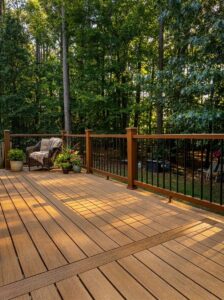
Custom Decks & Porches in Holly Springs, NC 27540
Holly Springs is one of the fastest-growing communities in Wake County, with new homes, expanding neighborhoods, and families looking to enjoy their outdoor space. Titan Decks builds custom decks and porches in Holly Springs, North Carolina (ZIP 27540) that are designed for comfort, durability, and everyday living.
Whether you want a backyard entertainment space, a quiet porch for relaxing, or a safe outdoor area for kids and pets, we create decks and porches that match your home and lifestyle.
Our Deck & Porch Services in Holly Springs
Composite Decks
Low-maintenance composite decks that resist fading, splintering, and warping — perfect for busy homeowners.
Wood Decks
Pressure-treated and cedar decks built with strong framing and proper drainage for long-term performance.
Covered Porches & Screened Porches
Porches that provide shade, airflow, and protection from insects so you can enjoy your space longer.
Deck Replacements
Full removal and rebuilding of outdated or unsafe decks common in older homes.
Stairs, Railings & Safety Upgrades
Modern railings and stair systems that improve safety and meet local code.
Why Materials Matter for Holly Springs Decks
Holly Springs experiences hot summers, heavy rain, and seasonal humidity. Using the right materials helps prevent:
Rot and moisture damage
Warping and cracking
Fading and surface breakdown
Structural safety issues
Titan Decks uses premium composite boards, treated lumber, and corrosion-resistant fasteners to ensure your deck or porch lasts.
Why Choose Titan Decks in Holly Springs
✔ Local experience serving Wake and surrounding counties
✔ Focused exclusively on decks & porches
✔ Custom designs tailored to your home and yard
✔ High-quality materials and craftsmanship
✔ Honest estimates and reliable scheduling
Serving Holly Springs & Nearby Areas
We proudly serve Holly Springs 27540, along with Fuquay-Varina, Apex, Cary, Garner, and surrounding Wake County communities.
Get a Free Deck or Porch Estimate in Holly Springs
If you’re ready to build or upgrade a deck or porch in Holly Springs, NC, Titan Decks is here to help.
The Professional’s Guide to Deck & Porch Engineering in Holly Springs, NC
Holly Springs is one of Wake County’s fastest-growing and most architecturally regulated communities. Subdivisions such as 12 Oaks, Sunset Ridge, South Lakes, and Judd Parkway developments include engineered fill lots, HOA restrictions, sloped rear grades, and high-end property expectations.
Building decks and porches in this environment requires structural precision. As a professional Deck Builder in Holly Springs, engineering decisions must account for:
Expansive clay beneath subdivision fill
Moisture-retentive subsoil
Elevated rear yard slopes
Wind uplift across open subdivisions
High UV exposure
HOA-controlled design standards
Strict Wake County code enforcement
A deck is not a platform. It is a structural system transferring live and dead loads safely into the earth while resisting environmental stress over decades.
This guide explains how professional engineering protects that system.
Soil Engineering in Holly Springs: Beyond Code Minimums
Subdivision Fill & Clay Interaction
Holly Springs developments often involve:
6–24 inches of compacted fill
Underlying clay-heavy native soil
Variable compaction quality
Fill soil can settle over time. When saturated, clay beneath expands. This combination produces unpredictable vertical movement.
If footings terminate within fill:
Settlement occurs
Posts lean
Deck surfaces slope
Stairs detach
As a seasoned Custom Deck Contractor, we extend footings below fill layers into undisturbed soil.
Shrink-Swell Clay Behavior
Clay particles expand when saturated and contract when dry.
Seasonal cycle in 27540:
Heavy summer storms → soil expansion
Extended heat → soil contraction
This produces cyclical uplift and settlement.
Footing Engineering in Holly Springs
Minimum 12-inch depth is rarely adequate in clay/fill environments.
We install:
20–30 inch diameter reinforced footings
24–36 inch depth
#4 rebar cages
Bell-bottom designs for increased bearing surface
Increasing diameter reduces soil pressure:
Example:
If load = 3,000 lbs
Footing diameter 12” = ~0.79 sq ft
Pressure = ~3,797 psf
Footing diameter 24” = ~3.14 sq ft
Pressure = ~955 psf
Lower psf reduces settlement risk.
Helical Pier Systems for Sloped Rear Lots
Many Holly Springs homes feature rear yard slopes.
Helical piers:
Bypass unstable upper soil
Anchor into stable strata
Resist uplift
Provide immediate structural capacity
Helical torque readings confirm load-bearing capacity.
Continuous Load Path & Structural Math
Load Path Principle
Deck loads must move:
Decking → Joists → Beams → Posts → Footings → Soil
Breaks in this chain create failure.
Live Load Requirements
North Carolina code requires:
40 pounds per square foot minimum live load.
But gatherings exceed this.
Example:
16’ x 16’ deck = 256 sq ft
256 × 40 psf = 10,240 lbs live load
Add dead load ~10 psf = 2,560 lbs
Total ≈ 12,800 lbs
Structure must distribute this evenly.
Beam Span Calculation Example
Deck width: 16 ft
Joist span: 14 ft
Tributary width per beam: 7 ft
Load per linear foot:
7 ft × 50 psf = 350 lbs per foot
14 ft beam = 4,900 lbs distributed
Beam depth must resist bending moment:
M = wL²/8
= (350 × 14²)/8
= 8,575 lb-ft
Proper beam selection prevents sagging.
Joist Deflection Control
Composite decking requires 12” on-center spacing.
Excess deflection causes:
Bounce
Fastener fatigue
Surface noise
We frequently:
Add mid-span blocking
Install secondary beams
Use LVL beams for long spans
Ledger Board Engineering & Failure Prevention
Improper ledger installation is the #1 cause of deck collapse.
Ledger must:
Attach to structural rim joist
Use ½” or ⅝” through-bolts
Include Z-flashing
Include self-adhered membrane
Brick veneer homes require penetration into structural framing — never attachment to veneer only.
Lateral tension devices (DTT2Z or equivalent) resist pull-away forces.
A professional Deck Builder in Holly Springs never skips lateral connectors.
Guardrail Engineering & 200-Pound Load Rule
Code requires:
200 lb concentrated load at top rail.
Improperly installed guard posts fail under load.
Correct installation:
Through-bolted posts
Blocking behind rim joist
Structural brackets rated for load
Face-screwed guard posts are unsafe.
Stair Geometry & Structural Integrity
Stair requirements:
Max 7¾” riser
Min 10” tread depth
Uniform rise variation ≤ ⅜”
Stringer span must be supported every 6 ft max.
We calculate:
Rise = total height ÷ number of steps
Run = consistent tread depth
Improper stair math causes code failure and trip hazards.
Moisture Physics & Humidity Engineering
Holly Springs Humidity Cycle
Summer dew points exceed 70°F.
Wood moisture content fluctuates between 12–20%.
Expansion coefficient of wood differs across grain.
Moisture cycling causes:
Board cupping
Fastener withdrawal
Surface checking
Butyl Joist Tape Science
Capillary action draws water into screw holes.
Butyl membrane:
Seals penetration
Prevents moisture intrusion
Extends framing lifespan 10+ years
Cross-Ventilation Strategy
Minimum 12–18 inch clearance.
Open perimeter airflow.
Vented skirting.
Air movement prevents fungal decay.
A knowledgeable Porch Builder integrates ventilation into structural planning.
Corrosion Science & Fastener Engineering
ACQ-treated lumber contains copper.
Copper + moisture = galvanic corrosion.
Electro-galvanized fasteners deteriorate rapidly.
We use:
304 stainless steel
316 stainless steel
G185 hot-dipped galvanized hardware
G185 contains 1.85 oz zinc per sq ft — triple G60.
Hardware determines lifespan.
Roof Load Engineering for Covered Porches
Roof load includes:
Dead load (shingles, sheathing)
Live load
Wind uplift
Lateral shear
Load path:
Roof → Rafters → Beam → Post → Footing → Soil
Improper roof tie-in causes:
Sagging
Wall separation
Water infiltration
We calculate tributary roof area and bending moments.
Thermal Expansion & Composite Engineering
Composite expansion coefficient ≈ 3–4× wood.
PVC expansion higher.
We engineer:
Expansion gaps
End spacing allowances
Floating clip systems
Heat mitigation pigments reduce surface temp 10–20°F.
Drainage Plane Engineering
Deck slope 1/8” per foot away from home.
Flashing layering:
Sheathing → Membrane → Z-flashing → Siding overlap
Proper flashing prevents rim joist rot.
Electrical & Lighting Code Integration
Low-voltage systems must:
Use wet-rated conduit
Include GFCI protection
Be accessible for maintenance
Improper wiring creates moisture risk.
HOA & Wake County Compliance
HOAs regulate:
Deck height
Railing style
Roof pitch
Impervious surface (30–35%)
Wake County inspections:
Footing
Framing
Final
Compliance protects resale value.
Material Performance Comparison
| Feature | Pressure-Treated Wood | Capped Composite | PVC |
|---|---|---|---|
| Structural Rigidity | High | Moderate | Moderate |
| Moisture Resistance | Moderate | High | Very High |
| UV Resistance | Low | High | Very High |
| Expansion Rate | Low | Moderate | High |
| Maintenance | High | Low | Very Low |
| Lifespan in Holly Springs | 10–15 yrs | 25+ yrs | 30+ yrs |
| Hardware Requirement | Stainless/G185 | Hidden Clips | Stainless |
Final Engineering Perspective
Deck and porch construction in Holly Springs requires:
Deep reinforced footings
Clay/fill soil stabilization
Lateral load connectors
Guardrail reinforcement
Humidity mitigation
Corrosion-resistant hardware
Roof load engineering
Thermal expansion allowances
Drainage control
HOA compliance
Hiring a professional Deck Builder in Holly Springs, experienced Porch Builder, or specialized Custom Deck Contractor ensures your structure is engineered — not just built.
The Future of Outdoor Living in Holly Springs: Smart Decks and Sustainability
As the 27540 real estate market becomes increasingly competitive, homebuyers are looking for more than just a backyard—they are looking for a fully integrated lifestyle extension. We are seeing a massive trend toward “Smart Decks” in new Holly Springs developments. This includes the integration of hardwired Wi-Fi extenders hidden within PVC post caps, ensuring seamless connectivity for outdoor offices, and the installation of low-voltage, dimmable LED systems that can be controlled via smartphone.
Beyond technology, there is a growing demand for sustainable, long-term building practices. In a town known for its high property standards, a deck that begins to rot or warp after five years is a significant liability to your home’s appraisal value. By utilizing high-performance, eco-friendly composite materials that are manufactured from recycled content, we provide Holly Springs homeowners with a “green” building solution that requires zero harsh chemical staining or painting over its 25-to-30-year lifespan. Investing in a professional, engineered build today ensures that when it comes time to sell, your outdoor space remains a top-tier asset that stands out to even the most discerning Wake County buyers.
Built to Impress. Proven to Last.
Trusted Craftsmanship, Backed by the Best
We partner with industry-leading brands to bring you top-quality decks, porches, exteriors, and pools—ensuring beauty, durability, and peace of mind with every installation.