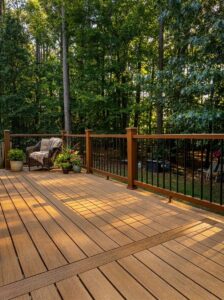
Outdoor Structures for Homes Near Williams Crossroads
Williams Crossroads is a rural-residential area where homes often sit on larger properties and outdoor space is a natural extension of daily living. Titan Decks designs and builds custom decks, porches, and outdoor structures for homeowners in and around Williams Crossroads who want functional, long-lasting outdoor spaces that fit their land and lifestyle.
From simple backyard platforms to fully covered outdoor rooms, we build structures that are safe, comfortable, and designed for North Carolina’s climate.
What We Build in Williams Crossroads
Services
Every project starts with how you plan to use the space. Common builds in this area include:
Backyard Decks
Custom-sized decks for grilling, seating, and entertaining, built with either composite or pressure-treated wood depending on your maintenance preference.
Covered Porches
Roofed porches attached to the home that provide shade, rain protection, and a cooler place to relax during hot summers.
Screened Porches
Porches with screened walls that allow airflow while keeping insects out — popular in rural areas.
Deck Replacements
Removal of old or unsafe decks and rebuilding with stronger framing, modern fasteners, and updated layouts.
Stairs, Landings & Access Features
Custom staircases, transition landings, and easy-access steps for safer movement between yard and home.
Railings, Lighting & Finishing
Modern railing systems, optional low-voltage lighting, and trim details that improve both safety and appearance.
Designing for Local Conditions
We design specifically for:
Clay-heavy soil requiring proper footing depth
High humidity that can trap moisture under decks
Heavy rain that requires proper slope and drainage
Strong sun that fades and heats surfaces
Our construction methods focus on ventilation, water management, and material selection that extends the life of your deck or porch.
Why Homeowners Choose Titan Decks
Homeowners in Williams Crossroads value practical contractors who communicate clearly and build things correctly. We focus on:
Accurate estimates with no surprises
On-time scheduling and jobsite cleanliness
Strong framing and code-compliant construction
Materials chosen for longevity, not just appearance
Nearby Areas We Serve
We also build in Clayton, Auburn, McGee Crossroads, Willow Spring, and Garner, and surrounding Johnston and Wake County communities.
Let’s Plan Your Outdoor Project
If you’re considering a deck, porch, or rebuild in the Williams Crossroads area, we’d be glad to walk your property, discuss options, and provide a clear plan and estimate.
The Professional’s Guide to Deck & Porch Engineering in Williams Crossroads, NC
Outdoor construction in Williams Crossroads requires structural awareness that goes far beyond basic carpentry. This area sits within a transitional zone of Johnston County where clay-heavy soil, rural drainage patterns, open-lot wind exposure, and intense sun combine to create a demanding environment for decks and porches.
As a professional Deck Builder in Williams Crossroads, every project begins with soil evaluation, structural load calculations, moisture mitigation planning, and long-term material performance analysis. A deck is not simply an outdoor platform. It is a structural system attached to your home that must safely transfer loads, resist environmental stress, and remain stable through seasonal cycles for decades.
This guide explains the engineering principles behind properly constructed decks and porches in Williams Crossroads and why hiring an experienced Custom Deck Contractor or skilled Porch Builder ensures durability in Johnston County conditions.
Soil Mechanics & Foundation Engineering in Williams Crossroads
Understanding Johnston County Clay Substructure
Williams Crossroads properties commonly feature:
Clay-dominant subsoil
Sandy clay loam top layers
Compacted rural backfill
Variable drainage conditions
Occasional shallow water tables
Clay-heavy soils in this region exhibit moderate to high shrink-swell capacity. This means soil volume changes significantly with moisture variation.
When soil absorbs water during heavy rainfall:
Clay particles expand
Vertical pressure increases beneath footings
Uplift forces develop
When dry heat follows:
Clay contracts
Voids form under shallow foundations
Structural settlement occurs
These seasonal cycles directly impact deck footings.
Why 12-Inch Footings Fail in Clay-Heavy Zones
Minimum 12-inch code depth frequently places footings within the “active zone” — the upper soil layer most affected by seasonal moisture changes.
In Williams Crossroads, shallow footings often experience:
Uneven uplift
Lateral shear stress
Rotational instability
Post misalignment
Stair separation
As a professional Deck Builder in Williams Crossroads, we typically install:
20–24 inch diameter reinforced concrete footings
Depths extending 24–36 inches below grade
Rebar reinforcement cages
Flared or bell-bottom bases for load distribution
Larger diameter footings reduce pounds-per-square-foot pressure and increase resistance to soil movement.
Soil Bearing Capacity & Load Calculations
Average soil bearing capacity in this area ranges from 1,500–2,000 psf depending on composition and compaction.
Deck loads include:
Dead load (structure weight)
Live load (minimum 40 psf per NC Residential Code)
Concentrated load at stair landings
Lateral wind loads
Footing size must distribute these loads evenly.
Improperly sized footings create stress points that accelerate settlement.
Helical Piers for Drainage-Prone Lots
Rural properties often contain poorly compacted fill or fluctuating moisture levels.
Helical piers:
Extend beyond unstable upper soil
Anchor into load-bearing strata
Resist uplift and settlement
Provide immediate structural stability
A qualified Custom Deck Contractor evaluates soil conditions before excavation.
Structural Engineering for Humidity & Rural Exposure
Williams Crossroads Climate Factors
Williams Crossroads experiences:
High summer humidity
Extended dew points
Strong sun exposure
Frequent heavy rain
Humidity impacts wood at the cellular level.
When wood moisture exceeds 20%:
Fibers swell
Deck boards cup
Fastener tension changes
Surface cracks form
Repeated moisture cycling weakens framing over time.
Fungal Decay & Airflow Engineering
Fungal organisms require:
Moisture
Warm temperatures
Oxygen
Under decks with limited ventilation, these conditions are common.
We engineer ventilation through:
Minimum 12–18 inch ground clearance
Open-perimeter construction
Ventilated skirting panels
Strategic spacing between decking boards
Proper airflow reduces decay risk significantly.
Butyl Joist Tape & Capillary Action
Each fastener penetration creates a potential moisture entry point.
Butyl joist tape:
Seals screw penetrations
Prevents capillary moisture migration
Blocks UV exposure
Extends joist lifespan
Moisture protection at the joist crown is critical for long-term durability.
A professional Porch Builder incorporates moisture science into framing design.
Fastener Chemistry & Corrosion Science
ACQ Lumber & Galvanic Reaction
Modern pressure-treated lumber contains copper-based preservatives.
Copper accelerates galvanic corrosion when paired with incompatible metals.
In high humidity environments like Williams Crossroads:
Electro-galvanized fasteners deteriorate quickly
Zinc coatings break down
Steel oxidizes
Structural connections weaken
Required Hardware Standards
We use:
304 stainless steel
316 stainless steel
G185 hot-dipped galvanized hardware
G185 contains significantly more zinc coating than standard G60 fasteners.
Hardware quality directly impacts structural longevity.
Load Path Engineering & Structural Math
Continuous Load Transfer
Deck loads must transfer through:
Decking → Joists → Beams → Posts → Footings → Soil
Interruptions in this path create structural failure points.
Beam Span Calculations
Beam size depends on:
Tributary load area
Post spacing
Deck width
Material species
Live load requirements
For wider decks common in rural lots, we often use:
Double or triple 2×12 beams
Laminated veneer lumber (LVL) beams
Reduced post spacing for added rigidity
Joist Spacing & Deflection Control
Standard 16-inch on-center spacing may allow excessive deflection with composite decking.
We frequently install:
12-inch on-center spacing
Blocking between joists
Mid-span beam support
Reducing deflection improves comfort and longevity.
Lateral Bracing & Wind Engineering
Open rural exposure increases wind velocity.
We incorporate:
Diagonal bracing
Tension ties
Hurricane-rated connectors
Through-bolted beam-to-post joints
Rigid framing reduces sway and bounce.
A skilled Deck Builder in Williams Crossroads designs for dynamic loads.
Roof Load Engineering for Covered Porches
Covered porches introduce additional structural loads:
Dead load from roofing materials
Live load requirements
Wind uplift pressure
Lateral shear forces
Load path:
Roof → Rafters → Beams → Posts → Footings → Soil
We calculate:
Tributary roof area
Beam sizing
Post compression strength
Connector ratings
Roof integration requires flashing and load anchoring that tie into existing framing without compromising home structure.
Drainage & Surface Water Management
Proper slope is critical.
We design decks with:
1/8 inch per foot slope away from home
Flashing above ledger boards
Spacing between deck boards
Downspout redirection away from footings
Poor drainage accelerates rot and soil instability.
Material Longevity Under Direct Sun
Williams Crossroads properties often lack mature tree canopy.
South-facing decks experience intense UV exposure.
UV degradation causes:
Wood lignin breakdown
Surface fading
Polymer oxidation
Composite vs PVC Performance
Composite:
Polymer cap
Lower expansion rate
High durability
PVC:
Fully synthetic
Superior moisture resistance
Higher thermal expansion
Heat mitigation pigments reduce surface temperature and improve comfort.
Technical Comparison Table
| Feature | Pressure-Treated Wood | Capped Composite | PVC |
|---|---|---|---|
| Structural Rigidity | High | Moderate | Moderate |
| Moisture Resistance | Moderate | High | Very High |
| UV Resistance | Low | High | Very High |
| Expansion Rate | Low | Moderate | High |
| Maintenance | High | Low | Very Low |
| Lifespan in Williams Crossroads | 10–15 yrs | 25+ yrs | 30+ yrs |
| Hardware Requirement | Stainless/G185 | Hidden Clips | Stainless |
Final Engineering Perspective for Williams Crossroads
Deck and porch construction in Williams Crossroads requires:
Deep, reinforced footings
Clay soil stabilization
Humidity mitigation engineering
Corrosion-resistant hardware
Lateral bracing systems
Roof load calculations
Drainage-aware design
UV-resistant materials
Hiring a professional Deck Builder in Williams Crossroads, experienced Porch Builder, or specialized Custom Deck Contractor ensures your structure is engineered for Johnston County conditions.
A properly engineered deck is calculated, reinforced, ventilated, and protected — built to perform safely for decades.
Built to Impress. Proven to Last.
Trusted Craftsmanship, Backed by the Best
We partner with industry-leading brands to bring you top-quality decks, porches, exteriors, and pools—ensuring beauty, durability, and peace of mind with every installation.