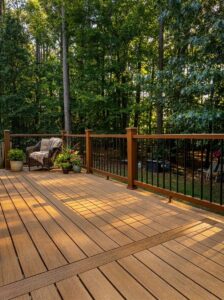
Outdoor Living for Wilson’s Mills Homeowners
Wilson’s Mills is a growing community with many newer homes and families looking to enjoy their outdoor space. Titan Decks designs and builds custom decks and porches in Wilson’s Mills, North Carolina (ZIP 27577) that add functional living space to modern homes while standing up to North Carolina’s climate.
Whether you’re adding a deck to a new build or upgrading a basic builder-grade structure, we help turn your backyard into a space you’ll actually use.
Titan Decks in Wilson’s Mills
What We Build in Wilson’s Mills
Our projects here often focus on usability, clean design, and long-term durability:
Backyard Decks
Sized for outdoor seating, grilling, and family gatherings, built with composite or wood depending on your maintenance goals.
Covered Porches
Roofed outdoor rooms that provide shade and rain protection for year-round comfort.
Screened Porches
Perfect for warm months — allowing airflow while keeping insects out.
Deck Replacements
Upgrading thin or undersized builder decks with stronger framing and better layouts.
Stairs, Railings & Safety Features
Modern stair systems and railings that improve access and meet code.
Lighting & Finishing Details
Optional low-voltage lighting, trim work, and finishing touches that improve usability and appearance.
Designed for Local Conditions
Wilson’s Mills experiences strong sun, seasonal rain, and humidity that can damage poorly built outdoor structures. We design decks and porches to:
Manage water with proper slope and drainage
Allow airflow beneath the structure
Resist moisture, warping, and fading
Remain structurally stable over time
Why Homeowners in Wilson’s Mills Choose Titan Decks
Homeowners here appreciate contractors who are organized, dependable, and transparent. Titan Decks is known for:
Clear estimates and honest pricing
Reliable scheduling and communication
Clean, respectful job sites
Building things correctly, not quickly
Nearby Areas We Also Serve
In addition to Wilson’s Mills (27577), we also work in Clayton, Smithfield, Powhatan, Garner, and Selma.
Let’s Plan Your Outdoor Project
If you’re considering a deck, porch, or rebuild in Wilson’s Mills, we’d be happy to discuss options and provide a clear estimate.
The Professional’s Guide to Deck & Porch Engineering in Wilson’s Mills (27577)
Wilson’s Mills sits at a unique crossroads of development, infrastructure exposure, and transitional soil conditions in Johnston County. Located along the I-95 corridor and within the rapidly expanding 27577 growth zone, outdoor structures here must be engineered for more than aesthetics.
As a professional Deck Builder in Wilson’s Mills, structural design begins with understanding:
Soil bearing characteristics
Drainage patterns near Neuse River tributaries
Subdivision lot constraints
Wind exposure from open corridor areas
Builder-grade framing limitations in newer homes
This guide outlines the structural science behind properly engineered decks and porches in Wilson’s Mills.
Soil Mechanics & Foundation Engineering in Wilson’s Mills
Johnston County Soil Profile in 27577
Wilson’s Mills features a mixed soil profile that often includes:
Sandy clay loam
Compactable fill soils in newer subdivisions
Silty deposits near low-lying drainage areas
High water table pockets near tributary zones
Unlike heavy red clay areas farther west, Wilson’s Mills soils often have faster drainage at the surface — but unstable compaction below.
Compacted Fill & Subdivision Risk
Many newer neighborhoods in 27577 were graded using compacted fill during development. Fill soil may not achieve long-term structural stability unless properly compacted to engineering standards.
If footings are placed in poorly compacted fill:
Settlement occurs
Posts shift
Deck surfaces become uneven
A skilled Custom Deck Contractor performs soil evaluation before excavation, ensuring footings extend below fill layers into undisturbed soil.
Why 12-Inch Footings Are Not Enough in Wilson’s Mills
Minimum code depth does not account for:
Fill instability
Water table fluctuation
Lateral washout risk
Long-term settlement
We frequently install:
20-inch diameter reinforced footings
24–30 inch depth in fill-prone areas
Rebar reinforcement for crack resistance
Elevated post bases to prevent ground contact
Helical Piers Near Drainage Corridors
Properties closer to low-elevation areas or near drainage swales benefit from helical pier systems.
Helical piers:
Anchor into stable strata
Resist uplift during soil saturation
Prevent deck heave
Stabilize structures in variable compaction soil
Proper foundation engineering separates a long-term structure from a temporary platform.
Wind Uplift & Highway Exposure Engineering
I-95 Corridor Wind Impact
Wilson’s Mills sits adjacent to open corridors along I-95. Open land exposure increases wind velocity impact on structures.
Elevated decks and covered porches must resist:
Lateral shear loads
Uplift forces
Dynamic wind pressure
Roofed Porch Uplift Calculations
Covered porches create uplift surfaces. Wind passing over roof planes generates negative pressure that attempts to lift the structure.
We engineer:
Hurricane-rated rafter ties
Through-bolted beam connections
Mechanical post anchors
Continuous load path systems
Continuous Load Path Design
Load must transfer:
Roof → Beams → Posts → Footings → Soil
Without proper tie-down hardware, uplift forces compromise structural integrity.
A professional Porch Builder understands wind engineering is not optional in exposed corridor areas.
Builder-Grade Deck Replacement Engineering
Many Wilson’s Mills homes were built with:
2×8 joists at maximum span
Minimal lateral bracing
Ledger boards installed without flashing
Electro-galvanized fasteners
These builder-grade decks often:
Sag prematurely
Experience rot at ledger points
Show excessive deflection
As a Deck Builder in Wilson’s Mills, we upgrade framing by:
Reducing joist span
Installing 12” on-center spacing for composite
Adding blocking to reduce bounce
Replacing ledger connections with through-bolts and flashing
Moisture & Drainage Engineering in 27577
Surface Water Management
Wilson’s Mills receives heavy seasonal rainfall. Deck surfaces must be sloped properly to shed water.
We design:
1/8” per foot slope away from home
Flashing above ledger boards
Gapped decking for drainage
Splash block or French drain redirection
Under-Deck Ventilation Strategy
Moisture accumulates beneath low-clearance decks.
Proper ventilation includes:
Open perimeter design
Minimum 12-inch clearance
Vented skirting
Cross-airflow channels
Humidity mitigation prevents fungal decay.
Fastener & Corrosion Science in Johnston County
ACQ-treated lumber contains copper.
Copper accelerates corrosion when paired with incompatible metals.
We use:
304 stainless steel
316 stainless steel
G185 hot-dipped galvanized hardware
Electro-galvanized fasteners fail prematurely in high-humidity environments.
Hardware selection determines structural longevity.
Code Compliance & Impervious Surface Limits in Wilson’s Mills
Johnston County enforces:
Footing inspection
Framing inspection
Final guard inspection
Subdivision HOA guidelines often regulate:
Deck size
Height
Railing style
Roof pitch for covered porches
Impervious surface limits often range from 30–35% of lot coverage.
Failure to calculate lot coverage can prevent permit approval.
Material Longevity in Direct Sun Exposure
Wilson’s Mills has less mature tree coverage in many new subdivisions. South-facing decks receive full sun.
Composite vs PVC in 27577
Capped Composite:
Durable cap layer
Moderate heat retention
Lower expansion than PVC
PVC:
Higher UV stability
Greater expansion/contraction
Lower moisture absorption
Heat mitigation pigments are critical for barefoot comfort.
Technical Comparison Table
| Feature | Pressure-Treated Wood | Capped Composite | PVC |
|---|---|---|---|
| Structural Rigidity | High | Moderate | Moderate |
| Moisture Resistance | Moderate | High | Very High |
| UV Resistance | Low | High | Very High |
| Expansion Rate | Low | Moderate | High |
| Maintenance | High | Low | Very Low |
| Lifespan in 27577 | 10–15 yrs | 25+ yrs | 30+ yrs |
| Hardware Requirement | Stainless/G185 | Hidden Clips | Stainless |
Final Engineering Perspective for Wilson’s Mills
Deck and porch construction in Wilson’s Mills requires:
Foundation systems beyond minimum depth
Wind uplift engineering
Builder-grade structural upgrades
Drainage-aware design
Corrosion-resistant hardware
UV-optimized material selection
Hiring a professional Deck Builder in Wilson’s Mills, experienced Porch Builder, or specialized Custom Deck Contractor ensures your structure is engineered for Johnston County conditions — not merely installed.
The Evolution of Outdoor Living in the 27577 Corridor
As Wilson’s Mills transitions from a rural landscape to a key residential hub in Johnston County, the philosophy of outdoor construction has shifted. For homeowners in newer developments, the standard 10×10 builder-grade pressure-treated deck is no longer sufficient for modern family life. We are seeing a significant trend toward “multi-generational” outdoor spaces—decks that incorporate wide-tread stairs for safety, integrated lighting for evening security, and reinforced framing designed to support the additional weight of luxury features like heavy granite-topped outdoor kitchens or high-capacity hot tubs.
Mitigating the “Heat Island” Effect in New Subdivisions
Many of the newer home sites in Wilson’s Mills lack the mature tree canopy found in established parts of the county. This results in intense, direct UV exposure for south- and west-facing backyards. When we design for these specific lots, we prioritize materials with high thermal stability. While traditional wood can crack and splinter under the relentless North Carolina sun, modern capped-polymer boards are engineered with cooling technology to stay significantly more comfortable underfoot.
Furthermore, we recommend integrating permanent shade structures—such as pergolas with polycarbonate covers or integrated porch gables—into the initial design. This isn’t just an aesthetic choice; it’s a structural necessity to ensure the space remains usable during the peak of summer. By calculating the sun’s trajectory relative to your home’s orientation, we position beams and rafters to provide maximum natural shade during the hottest hours of the day (typically 2:00 PM to 6:00 PM). This level of site-specific engineering ensures your investment adds genuine, year-round value to your Wilson’s Mills property, rather than becoming a “heat trap” that sits empty for three months of the year.
Built to Impress. Proven to Last.
Trusted Craftsmanship, Backed by the Best
We partner with industry-leading brands to bring you top-quality decks, porches, exteriors, and pools—ensuring beauty, durability, and peace of mind with every installation.