Custom Deck and Porch Construction for Smithfield Homes
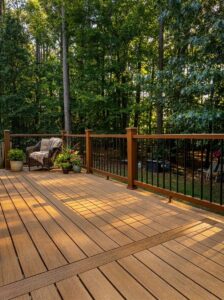
Smithfield is a mix of historic neighborhoods, established subdivisions, and new developments. Titan Decks is a local deck and porch builder serving Smithfield, North Carolina, helping homeowners upgrade their outdoor spaces with custom decks, covered porches, screened porches, and full rebuilds.
Whether your home is newer or decades old, we design structures that match your home’s style while improving usability, comfort, and value.
Why Choose Titan
Deck & Porch Services in Smithfield
Custom Deck Construction
Designed to fit your yard, your layout, and your lifestyle — not pre-built or cookie-cutter.
Composite Decks
Durable, low-maintenance decking that resists fading, warping, and moisture damage.
Traditional Wood Decks
Pressure-treated and cedar decks for a classic look with strong structural integrity.
Deck Replacements & Rebuilds
Tearing out aging or unsafe decks and replacing them with stronger, code-compliant structures.
Covered Porches
Roofed outdoor spaces for shade and weather protection.
Screened Porches
Enjoy the outdoors without insects, especially during warm months.
Stairs, Railings & Safety Upgrades
Custom access solutions and code-compliant railings for safety and ease of use.
Built for Smithfield’s Climate & Soils
Smithfield’s humidity, rainfall, and soil conditions require decks and porches to be built correctly from the ground up. We focus on:
Proper footings and spacing
Drainage and ventilation under structures
Corrosion-resistant fasteners
Materials designed for southeastern climates
Why Homeowners in Smithfield Choose Titan Decks
We specialize only in decks and porches
We provide clear estimates and honest timelines
We build to code and prioritize structural safety
We respect your home, neighbors, and property
Areas Around Smithfield We Also Serve
Wilson’s Mills • Clayton • Selma • Garner • Powhatan • McGee Crossroads
Request a Free Estimate in Smithfield
If you’re considering a new deck or porch in Smithfield, Titan Decks is ready to help.
The Professional’s Guide to Deck & Porch Engineering in Smithfield
Outdoor structures in Smithfield, North Carolina must be engineered for performance — not just appearance. Johnston County presents a unique mix of expansive clay soils, high humidity, intense summer heat, and frequent rainfall events that directly influence how decks and porches should be designed.
As a professional Deck Builder in Smithfield, structural integrity begins below grade and continues through every framing connection, fastener selection, ventilation detail, and material choice. True longevity requires understanding soil mechanics, moisture dynamics, corrosion science, local code enforcement, and UV exposure — all specific to southeastern North Carolina.
This guide explains the engineering behind properly constructed decks and porches in Smithfield and why working with an experienced Custom Deck Contractor or specialized Porch Builder ensures long-term structural performance.
NC Soil Mechanics & Foundation Stability in Smithfield, NC
Soil Conditions in Johnston County
Smithfield lies within North Carolina’s upper Coastal Plain transition zone. While Cecil Red Clay is more common in the Piedmont region, Johnston County contains expansive clay blends and sandy-clay loams that behave similarly under moisture fluctuations.
These soils exhibit high shrink-swell capacity, meaning:
When saturated, they expand.
When dry, they contract.
They exert vertical and lateral forces on shallow foundations.
This cyclical expansion and contraction places continuous stress on deck footings.
How Shrink-Swell Pressure Affects Deck Structures
Expansive soils increase in volume as water infiltrates the clay particles. During heavy rain events common in Smithfield, soil beneath deck footings may swell upward.
This causes:
Vertical uplift (“deck heave”)
Uneven post elevation
Stair separation
Lateral racking stress on framing
When the soil dries, contraction occurs, leaving voids beneath shallow footings. This results in:
Differential settlement
Load imbalance
Structural misalignment
A shallow 12-inch footing, while often code-minimum, remains within the active moisture zone — the top soil layer most affected by seasonal change.
Why Minimum 12-Inch Footings Are Often Insufficient in Smithfield
In Smithfield’s clay-heavy soil conditions, 12-inch footings frequently experience:
Seasonal uplift
Lateral shear movement
Rotational instability
As a professional Deck Builder in Smithfield, we routinely exceed minimum requirements by installing:
18–24 inch diameter concrete pads
Footings extending below active clay depth
Reinforced concrete with rebar cages
Widened bell-bottom footings for load distribution
Helical Piers for High-Risk Soil Zones
For properties near lower-elevation areas or drainage basins common around Wilson’s Mills or McGee Crossroads, we may use helical piers.
Helical piers:
Bypass reactive upper soil
Anchor into stable strata
Resist uplift pressure
Prevent long-term deck heave
This approach dramatically increases foundation stability.
A skilled Custom Deck Contractor understands that foundation engineering is the most critical structural decision in deck construction.
Structural Engineering for North Carolina Humidity
The Smithfield Micro-Climate
Smithfield experiences extended periods of high humidity, particularly during late spring and summer. Dew points frequently exceed 70°F, creating ideal conditions for moisture retention under decks.
Humidity interacts with wood at a cellular level. Wood is hygroscopic — meaning it absorbs and releases moisture depending on environmental conditions.
When moisture content rises above 19–20%:
Wood fibers expand
Boards widen
Surface cupping occurs
Fastener tension changes
Trapped Moisture & Fungal Decay
Under poorly ventilated decks, moisture becomes trapped.
Fungal decay organisms require:
Moisture
Oxygen
Warm temperatures
All three conditions are abundant beneath improperly ventilated structures in Smithfield.
Fungal decay weakens:
Joists
Beams
Ledger boards
Rim joists
As a specialized Porch Builder, we design decks to eliminate moisture accumulation through ventilation engineering.
Butyl Joist Tape: The Science Behind Frame Protection
Joist tape (butyl-based membrane) is applied to the top surface of joists prior to decking installation.
It prevents:
Water penetration at screw holes
Capillary moisture wicking
UV exposure of framing members
Each fastener penetration creates a potential moisture entry point. Butyl tape seals these penetrations, significantly extending structural lifespan.
Cross-Ventilation Strategy
We design for airflow using:
Open-perimeter construction
Vented skirting panels
Minimum 12-inch ground clearance
Strategic board spacing
The goal is constant air movement beneath the deck.
Humidity management is engineering — not optional detailing.
Fastener Science & Chemical Compatibility
ACQ-Treated Lumber Chemistry
Modern pressure-treated lumber in Smithfield uses Alkaline Copper Quaternary (ACQ) preservatives.
ACQ contains high levels of copper, which accelerates galvanic corrosion when paired with incompatible metals.
What Happens With Standard Fasteners
When standard electro-galvanized fasteners contact ACQ lumber:
Electrochemical reaction occurs
Zinc coating degrades rapidly
Rust forms
Structural capacity weakens
In high-humidity environments like Smithfield, corrosion accelerates significantly.
Approved Fastener Systems
To prevent failure, we use:
304-grade stainless steel fasteners
316-grade stainless steel (marine-grade)
G185 hot-dipped galvanized hardware
G185 provides 1.85 ounces of zinc per square foot — nearly triple standard coatings.
Fastener compatibility is structural science.
A qualified Deck Builder in Smithfield never compromises on hardware quality.
Permitting & Code Compliance in Johnston County, NC
Local Building Enforcement
Smithfield follows the North Carolina Residential Code, enforced by Johnston County Building Inspections.
Deck projects require:
Building permit
Footing inspection
Framing inspection
Final inspection
Impervious Surface Limits
Many subdivisions in Smithfield limit impervious surface coverage to approximately 30–35% of lot area.
Impervious surfaces include:
Decks
Covered porches
Concrete patios
Accessory structures
Failure to calculate lot coverage may result in permit denial.
As a Custom Deck Contractor, we verify lot coverage before design finalization.
Guardrail & Stair Code Requirements
Guard height: 36 inches minimum
Baluster spacing: less than 4 inches
Stair rise: max 7¾ inches
Tread depth: min 10 inches
Compliance ensures safety and resale protection.
Material Longevity in the NC Sun
UV Exposure in Smithfield
Smithfield receives intense summer sunlight. South-facing decks experience prolonged UV exposure.
UV degradation affects:
Wood lignin breakdown
Polymer surface fading
Heat retention
Capped Composite vs PVC
Capped Composite (Trex, TimberTech):
Wood-plastic core
Protective polymer shell
High scratch resistance
Moderate expansion rate
PVC (Azek):
Fully synthetic
Superior UV resistance
Low moisture absorption
Higher expansion coefficient
Heat Mitigation Technology
Modern decking includes:
Infrared reflective pigments
Advanced cap layers
Reduced heat absorption formulas
Heat mitigation is critical for south-facing backyard projects in Smithfield.
Technical Comparison Table
| Feature | Pressure-Treated Wood | Capped Composite | PVC |
|---|---|---|---|
| Structural Rigidity | High | Moderate | Moderate |
| Moisture Resistance | Moderate | High | Very High |
| UV Stability | Low | High | Very High |
| Expansion Rate | Low | Moderate | High |
| Maintenance | High | Low | Very Low |
| Expected Lifespan (Smithfield) | 10–15 yrs | 25+ yrs | 30+ yrs |
| Fastener Requirements | Stainless/G185 | Hidden Clip Systems | Stainless Recommended |
Final Engineering Perspective
Building in Smithfield requires:
Advanced soil stabilization
Humidity mitigation design
Corrosion-resistant hardware
Strict code compliance
UV-optimized material selection
Hiring a professional Deck Builder in Smithfield, experienced Porch Builder, or specialized Custom Deck Contractor ensures your deck or porch is engineered for Johnston County conditions — not merely built to minimum standards.
A properly engineered outdoor structure will remain level, secure, and structurally sound for decades.
Built to Impress. Proven to Last.
Trusted Craftsmanship, Backed by the Best
We partner with industry-leading brands to bring you top-quality decks, porches, exteriors, and pools—ensuring beauty, durability, and peace of mind with every installation.